
VAPAR MPUMALANGAHealth policy and systems research learning platform
Participatory tools developed by CHWs displayed for reference

Provincial scale-up 2024–26 · Enhancing CHW roles · Strengthening rural PHC

Tools in use.

Community Health Workers play a vital role in bridging the gap between communities and the health system, particularly in rural primary health care. Across 2024, the VAPAR community mobilization training was delivered across Mpumalanga’s three health districts to 57 CHWs and Outreach Team Leaders — who then taught what they had learned to at least 280 others, on their own initiative. Two policy briefs set out what happened, and the route from project to system.

Supported by the UK Medical Research Foundation · Changing Policy and Practice Award · 2024–26

57CHWs and OTLs trained directly — 40 CHWs · 17 OTLs
3health districts — Ehlanzeni · Nkangala · Gert Sibande
21/22interviewees passed their training on to others
≥280*additional people reached through peer sharing
* Self-reported minimum; training fidelity was not formally assessed. The evaluation comprised project documentation and 22 interviews with CHWs and OTLs across 22 clinics.

Province-wide delivery

Training across all three health districts

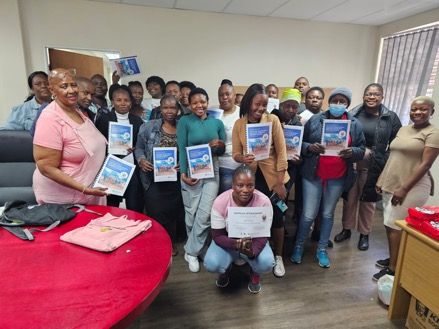
Training group in Ehlanzeni district
Ehlanzeni · May 2024
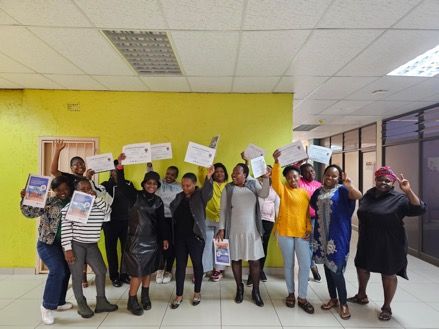
Training group in Nkangala district
Nkangala · July 2024
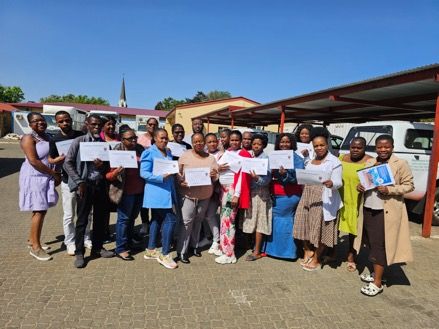
Training session in Gert Sibande district
Gert Sibande · September 2024

From the closing remarks · provincial workshop · 25 March 2025

We are pleased to confirm that the roles of Community Health Workers (CHWs) in Primary Health Care (PHC) have indeed been significantly enhanced through this initiative.

We must work together to unblock the barriers that prevent the scaling up of this model, including the lack of integration into routine health system structures.

Dr Cheryl Nelson Chief Director: Primary Health Care · Mpumalanga Department of Health

Read the long-form story

The briefs

Policy briefs: taking VAPAR to scale

Both draw on the same 2024–25 evaluation: project documentation and 22 interviews with CHWs and OTLs across 22 clinics. Written for provincial, district and sub-district PHC, Health Promotion, HRD, Regional Training Centre and programme managers, and partners supporting CHW-led community mobilization.

Policy brief 1 · The case

Embedding participatory learning to strengthen Primary Health Care

What the training adds to existing CHW and OTL training; six linked findings; seven recommendations for consolidation and scale-up; a twelve-month consolidation pathway; and the maternal and child health adaptation as the next use case.

Read brief 1 · PDF

Suggested citation: VAPAR Mpumalanga. Embedding participatory learning to strengthen Primary Health Care. Mpumalanga, South Africa: VAPAR and partners; 2026.
Policy brief 2 · The tool

A practical co-learning tool for CHW-led community mobilization in Primary Health Care

The co-learning cycle and its four tools; where the cycle sits in the system; the minimum scale-up package; and decision points for provincial owners.

Read brief 2 · PDF

Suggested citation: VAPAR Mpumalanga. A practical co-learning tool for CHW-led community mobilization in Primary Health Care. Mpumalanga, South Africa: VAPAR and partners; 2026.

Produced by VAPAR Mpumalanga with Mpumalanga Department of Health, the MRC/Wits Agincourt Unit and university partners, with support from the UK Medical Research Foundation.

The tools

Value in sequence

Each tool is simple on its own. Used in order, they carry a team from a recurring problem to shared analysis, clear roles, a workable plan and a record of what to pass on — then the cycle begins again.

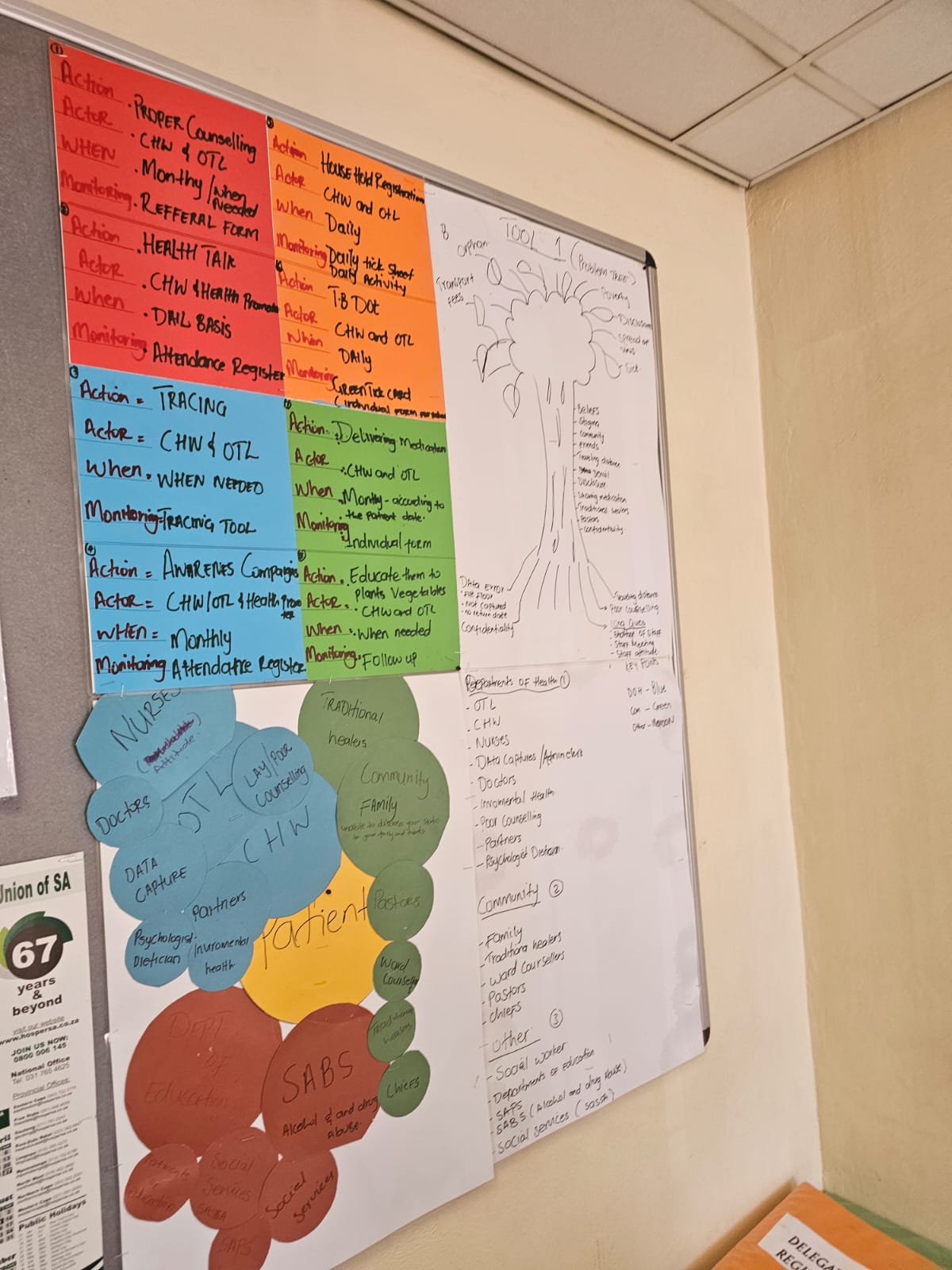
Participatory tools developed by CHWs displayed for reference
Participatory tools developed by CHWs after the community mobilization training and displayed in her office for reference in Nkangala District.
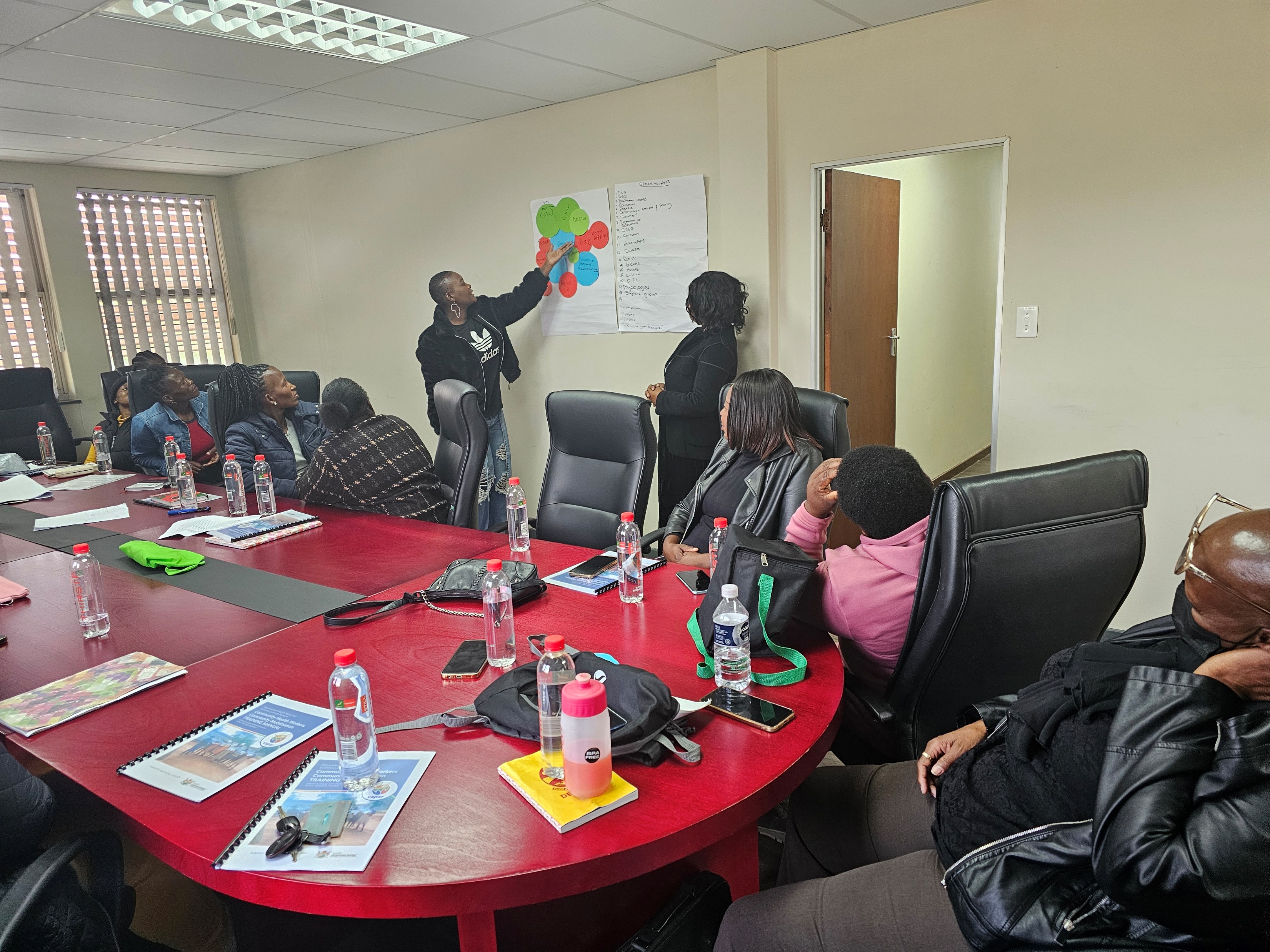
CHW presenting the stakeholder mapping Venn diagram during training
CHW presenting the stakeholder mapping (Venn diagram) to the group during week four of the training in Ehlanzeni district, following a group work session.
TOOL 01

Problem tree

Breaks a recurring problem into visible effects, immediate causes and deeper household, community, facility or system drivers.

Shared causal analysis: stigma, transport, clinic processes, poverty, communication and service barriers made visible.

TOOL 02

Stakeholder & Venn mapping

Maps actors, influence, relationships and possible support around the issue.

Clearer roles for CHWs, OTLs, operational managers, traditional leaders, families and other sectors.

TOOL 03

Action pathway

Turns the analysis into sequenced steps with named responsibilities, resources and deadlines.

An action plan for tracing, adherence support, referrals, health talks or facility-level change.

TOOL 04

Reflection & peer sharing

Reviews what changed, what blocked progress and what should be shared with others.

In-service learning, mentoring, refresher sessions and diffusion records.

Applied to real service priorities — treatment adherence · stigma · tracing and loss to follow-up · health-seeking behavior · referral coordination · household registration · community trust

The manual behind the tools:

CHW manual in English CHW manual in siTsonga

The evidence

Six linked findings

The evaluation synthesized training and project documentation, dissemination materials and 22 interviews with CHWs and OTLs across 22 clinics.

1

Confidence and role clarity

Participants reported greater confidence to speak, facilitate and raise concerns, and came to understand community mobilization as part of PHC work.

2

Practical use of tools

Problem trees and action pathways helped CHWs move from naming problems to analyzing causes, identifying stakeholders and planning action.

3

Teamwork and clinic–community feedback

CHWs, OTLs and facility staff reported improved coordination around tracing, follow-up, health talks and referrals — strongest where teams and supervision were stable.

4

Peer diffusion — the multiplier effect

21 of 22 interviewees shared their training through in-service sessions, mentoring and day-to-day support. One OTL reported training 49 CHWs at Embalenhle CHC.

5

Constraints shaping sustainability

Transport, uniforms, equipment, workload, protected time and literacy variation shaped who could apply and share learning: conditions to plan and budget for.

6

Early institutional uptake

Provincial actors positioned the training within revitalized Health Promotion, Regional Training Centre alignment, in-service registration discussions and roll-out planning.

Evidence status

How to read these numbers

The evidence supports claims of feasibility, acceptability, reported capability-building, peer diffusion and early institutional uptake. Diffusion counts are self-reported minimums, training fidelity was not formally assessed, and service effects and health outcomes need further prospective evaluation.

“…empowering CHWs allows them to address minor issues and regain community trust in the health system.”CHW · Ehlanzeni
“Every Friday, I do in-service training for CHWs, OTLs, and OPM. The OPM was the first to sign the register.”CHW Nkangala

Next phase

From project to system

The opportunity is incremental institutionalization: aligning the tools and facilitation approach with existing CHW curricula, Regional Training Centre processes, in-service training, OTL coaching and Health Promotion priorities — with a minimum enabling package behind it.

Months 1–2

Confirm provincial ownership and a technical working group across PHC, Health Promotion, HRD, RTC, district managers and VAPAR partners.

Months 2–4

Complete curriculum mapping, the facilitator package and simple quality-assurance tools for peer diffusion.

Months 4–6

Select demonstration sites; run refresher and calibration sessions for master trainers, OTLs and peer facilitators.

Months 6–12

Test the MCH/CHC adaptation in selected sites, review implementation data quarterly and refine before wider roll-out.

Next use case · VAPAR-LINC

Learning for Integrated Care: adapting the cycle for maternal and child health

Maternal and child health depends on coordination between pregnant women, households, CHWs, community health centre teams, referral hospitals and district managers. Mpumalanga Department of Health supports VAPAR-LINC, focused on increasing low-risk deliveries at CHCs, strengthening referral of obstetric complications, and coordinating the CHWs who screen pregnant women in the community.

The briefs are explicit that this is translation of an established co-learning model into integrated maternity care — MCH outcomes are for the next evaluation to demonstrate.